HomepageStoriesArticles Details

Advanced Driver Assistance Systems: In Search of those Decisive Fractions of a Second

Author: Alexander Föll

Jun 17, 2026

Intro-Text: Modern driver assistance systems in vehicles are increasingly helping drivers navigate critical traffic situations. But what happens if these sophisticated systems don’t function optimally? On behalf of the Service Division Vehicles, colleagues from the ADAS research group at the DEKRA Technology Center in Klettwitz investigated the potential effects of minimal misalignments in a car’s camera and radar sensors. As if by magic, the child dummy moves across the road in front of two parked cars, toward which a white test car is approaching at a speed of 30 km/h. The accident seems inevitable. His legs even suggest he is taking steps, but the little boy only becomes visible to the driver at the very last second. There is no time left for a human reaction.

Automated Driving and how the Emergency Braking Assistant Steps in where Humans Can no Longer

But then the test car’s emergency braking assistant intervenes in a fraction of a second: a camera and radar at the front of the vehicle have detected the crashtest dummy as a pedestrian, and the electronics just barely manage to slow down the nearly two-and-a-half-ton upper-mid-size car so that it comes to a stop a few centimeters before the dummy, stuttering to a halt with the help of ABS and with a slight squeal of tires. In a real-life scenario, the child’s life would be saved.
For ADAS (Advanced Driver Assistance Systems) such as the emergency braking assistant to perform their life-saving functions, cameras and radar systems must be optimally calibrated and adjusted. What happens if this is not the case? Project manager Felix Linke, his colleague Domenic Mann, and test driver Eric Föritz from the ADAS team are testing these scenarios on the new city course at the Lausitzring.
A shift in the viewing angle of between 3 and 5 degrees can occur if, for example, the windshield is replaced and the camera is not recalibrated. Such a deviation is still within the system’s tolerance range. No error message will be displayed, and the driver assumes that everything is fine. Even small, unnoticed parking bumps could minimally misalign the radar sensors built into the car’s front or rear bumper, according to the 27-year-old. Leader
Felix Linke, ADAS Test

Improvement in Obstacle Detection: The Use of Driving Robots Guarantees Precise Results
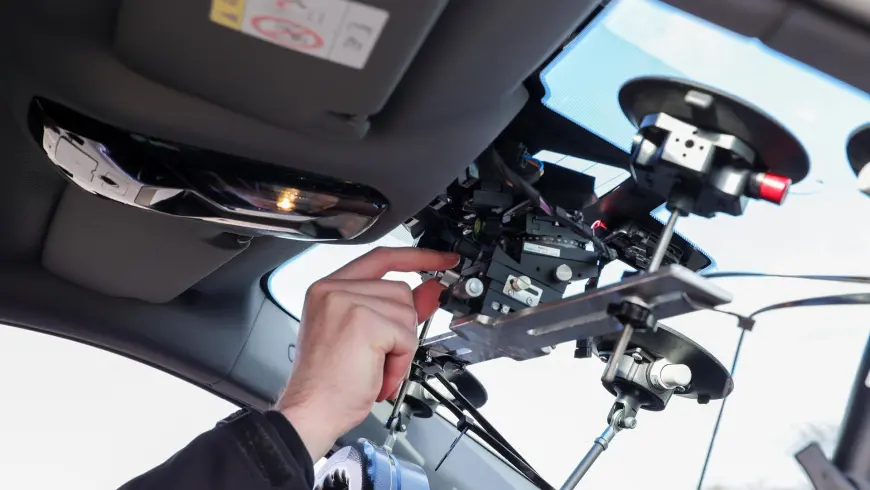
For the tests, Linke’s team exposed the camera built into the test car’s windshield. It can now be adjusted slightly using a turntable and adjustment wheels mounted on a frame of aluminum rails that is attached to the windshield from the inside and secured within the cabin.
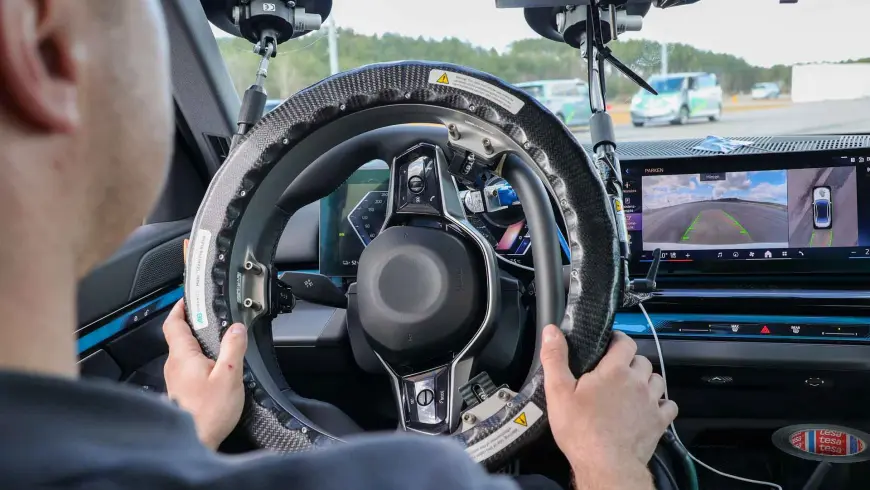
The team also has access to other state-of-the-art tools: For example, a driving robot uses GPS data to keep the white test car at a constant speed and precisely on course. Test driver Eric Föritz simply brings it to its respective starting position. However, he can intervene at any time.
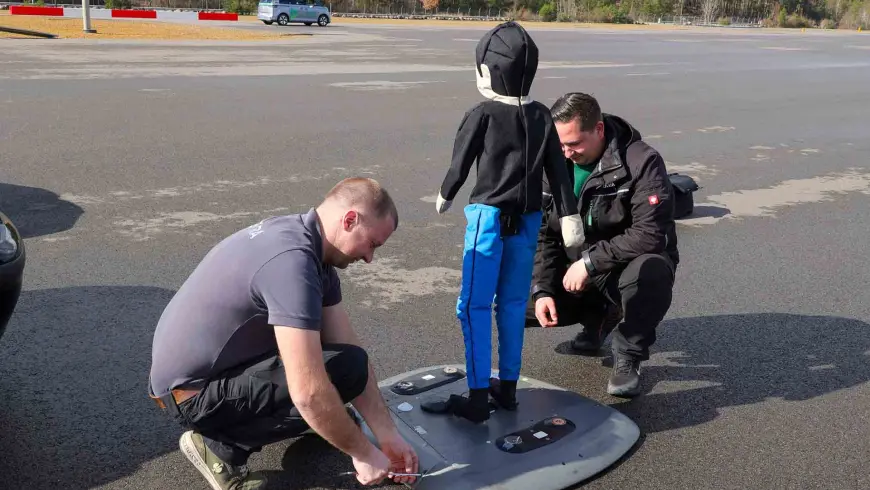
  • The ADAS team prepares the child dummy on a movable platform for the next test runs at the Lausitzring
  •  Test driver sits in the test vehicle behind a steering wheel equipped with driving robot technology, while monitors display driving data and camera images from the ADAS test runs at the Lausitzring.
  •  A DEKRA employee’s hand adjusts a mount installed on the inside of the windscreen in a test vehicle, allowing the ADAS camera to be finely repositioned for test runs.
The platforms on which the child dummy and the car dummy for subsequent tests are mounted also move into position automatically via computer control. “This makes our driving tests fully reproducible and ensures they run with an accuracy of two centimeters,” says Linke. The vehicles are connected to each other via Wi-Fi, and everything is coordinated from Domenic Mann’s technical vehicle, an electric ID. Buzz. Five identical tests per scenario are recorded entirely digitally and evaluated later.
The deviations in the functioning of the assistance systems caused by the adjustments are barely noticeable to the naked eye. They are limited to fractions of a second in which the systems trigger later. This can possibly result in the vehicle coming to a stop a few centimeters later than it would with properly calibrated cameras. Yet it is precisely these seemingly tiny differences that can save lives in an emergency.

Conclusion: Regular Inspection as Part of the Annual Car Inspection is Advisable

This is also the case in another test, in which the test car collides at 50 km/h with a dummy vehicle traveling ahead at 20 km/h. The “Softcar 360” is made of foam and is also mounted on a self-driving platform. Here, too, the test car manages to avoid a collision, though only by a hair’s breadth. A third test shows both vehicles, which are initially accelerated to 50 km/h. Suddenly, the “Softcar 360” brakes sharply, but the test vehicle continues on and is then braked again by the emergency braking assistant—here, too, a collision is avoided. What do these driving tests demonstrate?
We were able to show that the correct adjustment and calibration of the environmental sensors is necessary for the reliable functioning of ADAS. Even minor sensor misalignments within the tolerance range limit functionality and can reduce road safety potential. Regular inspection of the ADAS, including the sensors—for example, as part of the vehicle inspection—therefore seems advisable to ensure the effectiveness of driver assistance systems throughout the vehicle’s lifespan.
Felix Linke, ADAS Test Leader
Learn more:
Share page :